Tuesday, July 8, 2008

Iraq, Standing For Independence

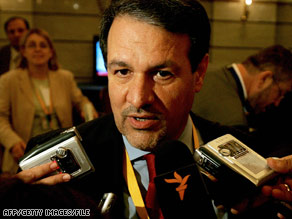
A deadline should be set for the withdrawal of U.S. and allied forces from Iraq, and the pullout could be done by 2011, an Iraqi government spokesman said Tuesday.

Ali al-Dabbagh said any timetable would depend on "conditions and the circumstances that the country would be undergoing." But he said a pullout within "three, four or five" years was possible.

"It can be 2011 or 2012," al-Dabbagh said. "We don't have a specific date in mind, but we need to agree on the principle of setting a deadline."

Al-Dabbagh's comments come as the United States and Iraq try to negotiate a framework governing the stationing of U.S. and allied troops beyond the end of 2008, when the current U.N. mandate for coalition forces expires. Bounce 2 CNN for the rest of the story.

Sunday, July 6, 2008

Saturday, July 5, 2008

Obama on Iraq

Obama said he had not changed his position regarding Iraq troop withdrawals, but that he could "refine" his policy after assessing the situation there.

This, of course, echoes what Obama said at the Sept. 26 NBC News/MSNBC debate from Dartmouth, N.H., (see full transcript below) when neither he nor Clinton nor Edwards would commit to having troops out by 2013.

"I think it's hard to project four years from now, and I think it would be irresponsible," Obama said then. "We don't know what contingency will be out there. What I can promise is that if there are still troops in Iraq when I take office, which it appears there may be unless we can get some of our Republican colleagues to change their mind and cut off funding without a timetable, if there's no timetable, then I will drastically reduce our presence there to the mission of protecting our embassy, protecting our civilians and making sure that we're carrying out counterterrorism activities there.

"I believe that we should have all our troops out by 2013, but I don't want to make promises not knowing what the situation's going to be three or four years out."


At a brief press conference on the tarmac here Thursday, the presumptive Democratic nominee said his plan to withdraw troops within 16 months had always been dependent on the facts on the ground and that he would "do a thorough assessment" of the situation when he visits Iraq, a trip he has said he wants to make before the election.

“My position has not changed but keep in mind what that original position was. I have always said that I will listen to commanders on the ground; I’ve always said that the pace of withdrawal would be dictated by the safety and security of our troops and the need to maintain stability," he said. "That assessment has not changed and when I go to Iraq and I have a chance to talk to some of the commanders on the ground, I’m sure I’ll have more information and will continue to refine my policies.”


Later, Obama came back out and addressed it again:
"Apparently I wasn’t clear enough this morning on my position with respect to the war in Iraq. I have said throughout this campaign that this war was ill conceived, that it was a strategic blunder and that it needs to come to an end. I’ve also said that I will be deliberate and careful in how we got out, that I would bring our troops home in the pace of one to two brigades per month and that that pace we would have our combat troops out in 16 months. That position has not changed.

"I have not equivocated on that position. I am not searching for maneuvering room with respect to that position. What I said this morning and what I will repeat because its consistent with what I have said over the last two years is that in putting this plan together, I will always listen to the advice of commanders on the ground but that ultimately I’m the person who is making the strategic decisions and it is my view that strategically for us to perpetuate this war in Iraq the way that John McCain has proposed and neglect the extraordinary problems that we’re seeing in Afghanistan, to continue spend $10 to 12 billion a month, to continue to put enormous burdens on our military and military families, is not the best way to make the American people safe.

"So we are going to go visit Iraq, I want to have conversations with commanders on the ground, Iraqi officials. When I come back, that information will obviously inform how we shape our plans moving forward. For example, does it-- what is the current training situation and how many residual troops might be needed in order to train Iraqis to stand up both the army and the police? What is the current posture in terms of negotiations between the various Iraqi factions on critical issues like how oil is distributed, oil revenues are distributed?

"But, you know, let me be as clear as I can be, I intend to end this war. My first day in office I will bring the joint chief of staff in and I will give them a new mission and that is to end this war responsibly, deliberately, but decisively. And I have seen no information that contradicts the notion that we can bring our troops out safely at a pace of one to two brigades a month and again that pace translates into having our combat troops out in 16 months time. ...

"[T]his is the same position that I had four months ago; it’s the same position that I had eight months ago; it’s the same position that I had 12 months ago."
Monday, June 30, 2008

Bush's War

Bush signs $162 billion war spending bill
The legislation will bring to more than $650 billion the amount Congress has provided for the Iraq war since it began more than five years ago. For operations in Afghanistan, the total is nearly $200 billion, according to congressional officials.

Yes, that means $850 Billion...with $1 Trillion in sight, which will be passed by next year at this time. So I can go with the $200 Billion in Afghanistan but the $650 Billion in Iraq...where is the value for the USA in this Treasury expense?

Thursday, June 26, 2008

Quote of the Day

“There is a sense in this country that in my belief is anti-intellectual. There is almost a case to be made against smart people and that has penetrated I think from the top leadership in this country right through the ‘hood’ where people look down on folk who are academically prepared gifted and we’ve gotta change this culture,” he said. “America is fascinated by whether you can drink a beer. That’s not, that should not be the qualification for a president. A president ought to be able to lead the nation in a direction where young people aspire for the kind of genius that’s around this table.”
Geoffrey Canada, the president and CEO of Harlem Children's Zone at Carnegie Mellon University, Competitiveness Summit

NFL, Breaking Down the AFC North

2nd Amendment

In a dramatic moment on the last day of this term, the Supreme Court declared (5-4) for the first time that the Second Amendment protects an individual's right to self-defense and gun ownership.

For most of the last century, the interpretation of the Second Amendment has been that the right to bear arms is a collective right, such as with military service; Thursday's ruling says gun ownership is an individual right.

In Thursday's ruling, Justice Antonin Scalia, writing for four colleagues, said the Constitution does not permit
"the absolute prohibition of handguns held and used for self-defense in the home." He added, however, that nothing in Thursday's ruling should "cast doubt on long-standing prohibitions on the possession of firearms by felons or the mentally ill, or laws forbidding the carrying of firearms in sensitive places such as schools and government buildings."

In dissent, Justice John Paul Stevens wrote that the majority of justices
"would have us believe that over 200 years ago, the Framers made a choice to limit the tools available to elected officials wishing to regulate civilian uses of weapons." Stevens said such evidence "is nowhere to be found."

Wednesday, June 25, 2008

NBA Draft...Go Blazers!

Kevin Pritchard leading up to Thursday's draft


Tuesday, June 24, 2008

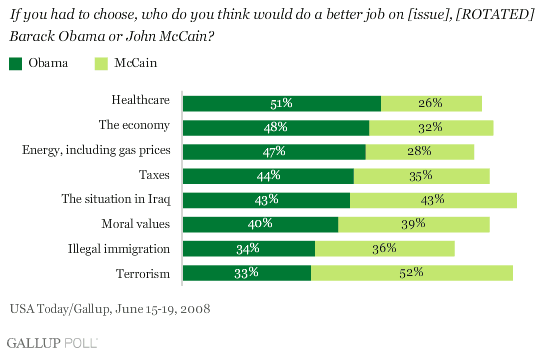
Gallup Poll: The Issues

Click below to see Gallup Video (2:13) for the details

Sunday, June 22, 2008

UN classifies rape a 'war tactic'

The UN Security Council has voted unanimously in favour of a resolution classifying rape as a weapon of war.
The document describes the deliberate use of rape as a tactic in war and a threat to international security.

UN Secretary General Ban Ki-moon said violence against women had reached "unspeakable proportions" in some societies recovering from conflict.

The UN is also setting up an inquiry to report next June on how widespread the practice is and how to tackle it.

Human rights groups hailed the resolution as historic.
To read full article Bounce 2 BBCNews Click for BBC NEWS Video

Saturday, June 21, 2008

One Day in Darfur

Who Owns The West?

This map details the percentage of state territory owned by the federal government. The top 10 list of states with the highest percentage of federally owned land looks like this:

Nevada 84.5%
Alaska 69.1%
Utah 57.4%
Oregon 53.1%
Idaho 50.2%
Arizona 48.1%
California 45.3%
Wyoming 42.3%
New Mexico 41.8%
Colorado 36.6%

Notable is that all these states are in the West (except Alaska, which strictly speaking is also a western state, albeit northwestern). Also notable is the contrast between the highest and the lowest percentages of federal land ownership. The US government owns a whopping 84.5% of Nevada, but only a puny 0.4% of Rhode Island and Connecticut. Courtesy Strange Maps

The Stat That Counts

Is this one:
Among independents — the group that usually determines election outcomes — Obama leads 48%-36%.

Obama's First General Election Ad: "Country I Love"

Obama on FISA

Obama on the FISA 'Compromise' ...
"Given the grave threats that we face, our national security agencies must have the capability to gather intelligence and track down terrorists before they strike, while respecting the rule of law and the privacy and civil liberties of the American people. There is also little doubt that the Bush Administration, with the cooperation of major telecommunications companies, has abused that authority and undermined the Constitution by intercepting the communications of innocent Americans without their knowledge or the required court orders.
"That is why last year I opposed the so-called Protect America Act, which expanded the surveillance powers of the government without sufficient independent oversight to protect the privacy and civil liberties of innocent Americans. I have also opposed the granting of retroactive immunity to those who were allegedly complicit in acts of illegal spying in the past.

"After months of negotiation, the House today passed a compromise that, while far from perfect, is a marked improvement over last year's Protect America Act.

"Under this compromise legislation, an important tool in the fight against terrorism will continue, but the President's illegal program of warrantless surveillance will be over. It restores FISA and existing criminal wiretap statutes as the exclusive means to conduct surveillance - making it clear that the President cannot circumvent the law and disregard the civil liberties of the American people. It also firmly re-establishes basic judicial oversight over all domestic surveillance in the future. It does, however, grant retroactive immunity, and I will work in the Senate to remove this provision so that we can seek full accountability for past offenses. But this compromise guarantees a thorough review by the Inspectors General of our national security agencies to determine what took place in the past, and ensures that there will be accountability going forward. By demanding oversight and accountability, a grassroots movement of Americans has helped yield a bill that is far better than the Protect America Act.

"It is not all that I would want. But given the legitimate threats we face, providing effective intelligence collection tools with appropriate safeguards is too important to delay. So I support the compromise, but do so with a firm pledge that as President, I will carefully monitor the program, review the report by the Inspectors General, and work with the Congress to take any additional steps I deem necessary to protect the lives - and the liberty - of the American people."
Courtesy Talking Points Memo

Another look at FISA from Andrew Sullivan and Glenn Greenwald

Do you Teach or Do you Educate?

Friday, June 20, 2008

Obama’s Public Funding Opt-Out


CQ Politics addresses the questions concerning the state of public funding within the context of Obama’s decision.

1. How does the presidential public financing system work?
There are separate public financing systems for the primary and general presidential elections. Both are optional, and a candidate is free to participate in one or the other, or both, depending on qualifications.

The general election financing program covers the period of time between the candidate’s official nomination at the party convention and election day in November. The presidential nominee for each major party is automatically eligible for public funding. Minor party candidates may also qualify for partial funding, determined by their party’s vote totals in the preceding presidential election. If he or she chooses to participate, the candidate receives a grant adjusted for inflation. For 2008, that amount is approximately $84.1 million. The candidate may not raise or spend any additional funds, except to cover legal and accounting expenses.

2. Why did Obama decide to opt out of the public financing system?
Obama said he made the decision because “the public financing of presidential elections as it exists today is broken, and we face opponents who’ve become masters at gaming this broken system.” But the bottom line is the campaign does not want to stop raising and spending its own money. The soon-to-be Democratic nominee has already shown the capacity to raise much more than $84 million over the same roughly two-month period that would be covered in the general election campaign. He raised $56.8 million in February, alone. Given his fundraising abilities, and considering Sen. John McCain ’s own funding struggles, Obama is likely to have a huge advantage over his Republican rival by the time the conventions roll around. Taking public funding would neutralize that.

In making the decision, the Obama campaign no doubt weighed the fact that the Republican National Committee presently has a significant cash advantage over the Democratic National Committee – $40.6 million to $4.4 million at the end of April — putting the Republican party in a position to outspend the Democrats on presidential race.

The parties and other outside interest groups can spend unlimited amounts to influence the election. In 2004, the spending totalled more than $200 million.


Some say it is hypocritical of Obama to have went back on his early statement...he is a politician. If I were advising Obama I would counter this argument by stating, "our campaign is a grass roots network of donors and volunteers. The average donation is less than $100...coming from hard working Americans...the backbone of our great democracy. We are not following the McCain strategy of tapping lobbyists and corporate giants as if they were offshore oil wells."

What Do Teachers Really Make? Taylor Mali Explains...

Thursday, June 19, 2008

2 Cents for Drilling in ANWR

John McCain wants to open up Artic National Wildlife Refuge (ANWR) to oil drilling in order to provide more energy independence for the United States and alleviate high prices at the gas stations. A recent economic analysis from the Energy Information Administration:
The opening of the ANWR 1002 Area to oil and natural gas development is projected to increase domestic crude oil production starting in 2018. In the mean ANWR oil resource case, additional oil production resulting from the opening of ANWR reaches 780,000 barrels per day in 2027 and then declines to 710,000 barrels per day in 2030 ... Crude oil imports are projected to decline by about one barrel for every barrel of ANWR oil production ... Additional oil production resulting from the opening of ANWR would be only a small portion of total world oil production, and would likely be offset in part by somewhat lower production outside the United States. The opening of ANWR is projected to have its largest oil price reduction impacts as follows: a reduction in low-sulfur, light crude oil prices of $0.41 per barrel (2006 dollars) in 2026 for the low oil resource case, $0.75 per barrel in 2025 for the mean oil resource case, and $1.44 per barrel in 2027 for the high oil resource case, relative to the reference case.


The median case suggests the effect on gasoline prices in 2025 will be a mere $0.02 a gallon. The immediate effect will be zero as we’ll have to wait a decade to see any oil from ANWR. If this is Bush’s and McCain’s answer to today’s high gasoline prices, it is no answer at all.

Wednesday, June 18, 2008

McCain's Energy Solutions Impact Environment

By calling for an end to the federal ban on offshore oil drilling, John McCain is placing a risky bet. He is wagering that skyrocketing gas prices have finally reached a tipping point, a threshold moment that has led voters to rethink their strong and long-held opinions against coastal oil exploration.

The stakes couldn’t be higher: If he is wrong, McCain will have seriously damaged his chances in two key states with thousands of miles of coastline — California and Florida — and where opposition to offshore oil drilling has been unwavering. And he will have undermined some of his closest political allies in those states and others, including potential fall battlegrounds such as Virginia and North Carolina.

In addition, Sen. John McCain is calling for construction of 45 new nuclear reactors by 2030 and pledging $2 billion a year in federal funds to make clean coal a reality. He says the measures will reduce American dependence on foreign oil.

McCain is rolling the dice on these proposals and hoping that people are willing to sacrifice their environments for cheaper energy. I would not be advising McCain in this way but his advisers are feeling the pinch early to curtail Obama's popularity.

These proposals further link John McCain to President Bush see video below.